Quick Quest Brief: Sail past cliffside castles on Europe's historic waterways. Compare medieval Germany river cruises, the castle-dense Rhine gorge, and Hanseatic ocean routes with pricing and packing checklists.
Why Medieval Cruises?
Imagine sailing the same rivers that merchants, knights, and pilgrims traveled centuries ago. Medieval river cruises through Europe turn history into a living experience — you wake up in a luxury cabin, have breakfast with a view of crumbling castles, and spend the afternoon walking cobblestone streets that haven't changed since the 13th century.
Unlike conventional ocean cruises, medieval river cruises are intimate and culturally immersive. The ships are smaller (typically 150-190 passengers), sail rivers like the Rhine, Main, and Danube, and dock directly in the center of historic towns. No tenders needed — you step off the ship and you're literally inside the medieval city.
For anyone who loves history, RPGs, medieval fantasy, or simply old-world architecture, these cruises are the real-life equivalent of an epic quest. You're following trade routes that have existed since the Middle Ages, visiting cathedrals that took centuries to build, and tasting wines from vineyards that have been operating for generations.
In this guide, we cover three of the best medieval cruises available — each with a different route, style, and budget.
1. Riviera Travel — Medieval Germany: Bavaria and the Romantic Road
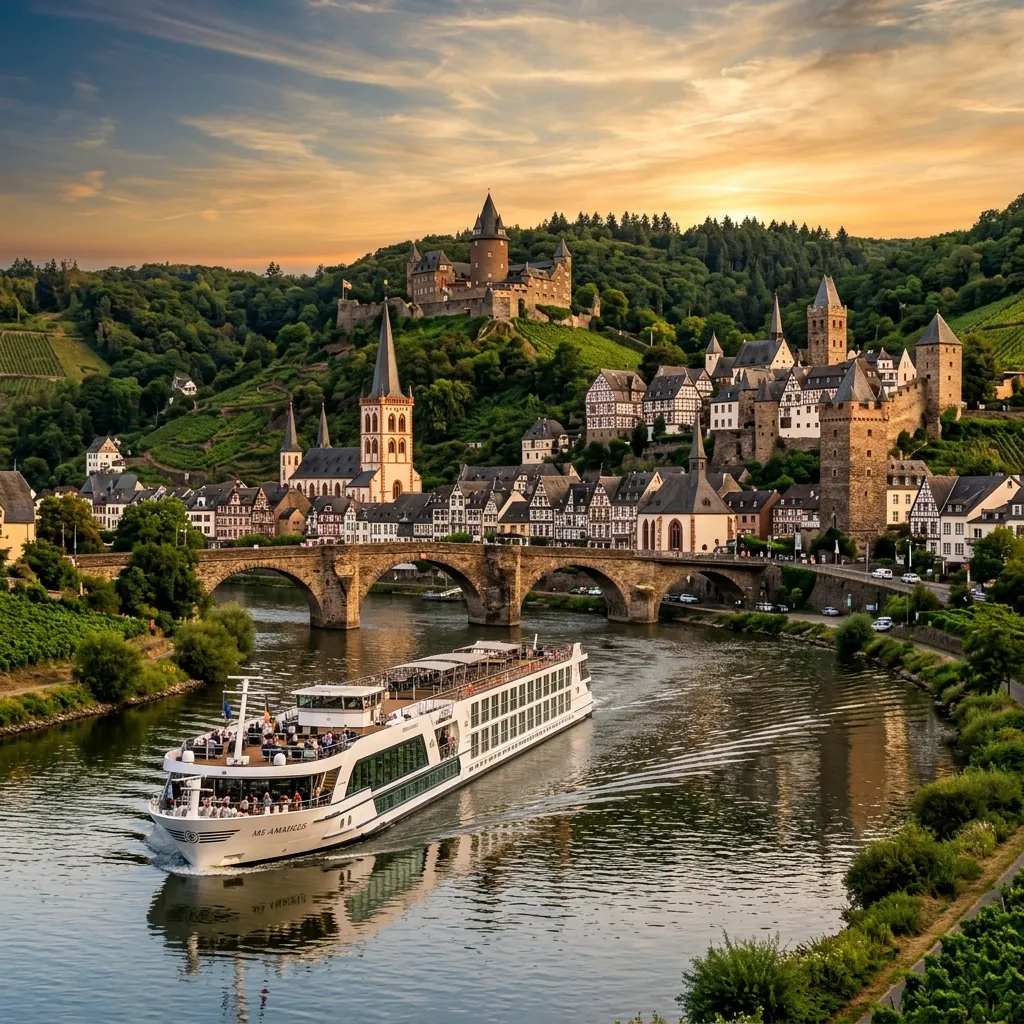
A medieval German town with half-timbered houses and a church tower seen from the banks of a European river
Riviera Travel offers the Medieval Germany: Bavaria and the Romantic Road cruise, an 8-day journey along the Main River and the Main-Danube Canal. It's the most focused on medieval Germany and one of the most affordable options.
Route: Mainz → Miltenberg → Wertheim → Würzburg → Rothenburg (via Romantic Road) → Bamberg → Nuremberg
Duration: 8 days / 7 nights
Price: From $2,849 per person
What to Expect:
Days 1-2 — Mainz: Arrival and boarding your five-star cruise ship. Guided city tour featuring St. Martin's Cathedral (12th-century Romanesque architecture) and St. Stephen's Church, home to nine stunning stained glass windows created by Marc Chagall. Visit the Gutenberg Museum, which houses two 1455 Gutenberg Bibles — among the first books ever printed.
Day 3 — Miltenberg & Wertheim: Miltenberg is a perfectly preserved medieval village with a labyrinth of winding alleys and lanes. The highlight is the marketplace with its half-timbered (fachwerk) buildings and the Gasthaus Zum Riesen, which claims to be Germany's oldest tavern. In the afternoon, sail to Wertheim with a traditional glassblowing demonstration.
Day 4 — Würzburg: A baroque city dominated by the imposing Würzburg Residence (UNESCO World Heritage Site), which features the world's largest ceiling fresco, painted by Tiepolo. Guided city tour with free time to explore.
Day 5 — Rothenburg ob der Tauber: Excursion along the Romantic Road — a legendary route of folkloric landscapes, medieval towns, lofty castles, and grand palaces. Rothenburg is the crown jewel: a walled medieval town with cobblestone streets, half-timbered houses, and immaculately preserved ramparts. It's like stepping into an RPG setting.
Day 6 — Bamberg: A UNESCO World Heritage Site, Bamberg is one of the few German cities to survive World War II virtually intact. The Old Town Hall (Altes Rathaus), built on a bridge in the middle of the river, is one of the most photographed buildings in Germany. The city is also famous for its smoked beer (Rauchbier).
Days 7-8 — Nuremberg: The final stop is Nuremberg, with its imposing 11th-century Imperial Castle (Kaiserburg), the walled old town, and the Germanic National Museum. Guided tour and disembarkation.
Why Choose This Cruise: It's the most affordable of the three and the most focused on "classic" medieval Germany. The Romantic Road excursion is a unique highlight. Ideal for those wanting a deep immersion in Bavarian culture and history.
Link: rivieratravel.com
2. AmaWaterways — Medieval Treasures
AmaWaterways offers the Medieval Treasures cruise, sailing the Rhine River. It's the most luxurious option with the most services included.
Route: Rhine River cruise with stops at medieval towns across Germany and the region
Duration: 7 nights
What to Expect:
AmaWaterways is known for its premium ships with spacious suites, multiple restaurants (including the main dining room with the Chef's menu and The Chef's Table with a tasting menu), and a heated observation platform on top of the ship.
Itinerary Highlights:
- Rhine Valley Sailing: The most spectacular stretch of the river, with medieval castles on both banks. Around every bend, a new ruined fortress or picturesque village appears. This section is a UNESCO World Heritage Site
- Medieval towns along the Rhine: Visits to towns with preserved historic centers, Gothic cathedrals, and market squares that have been operating for centuries
- Included excursions: Unlike many cruises, AmaWaterways includes guided excursions at every port, plus cycling options for the more active travelers
- Culinary experiences: Regional Rhine wine tastings, themed dinners with local cuisine, and the "Sip & Sail" program with complimentary drinks
AmaWaterways Differentiators:
- Ships with a maximum of 156 passengers — intimate experience
- Complimentary bicycles on board for exploring ports independently
- Wellness program with a swim-against-the-current pool
- Local guides specialized in medieval history
- Complimentary Wi-Fi throughout the ship
Why Choose This Cruise: It's the most premium option with the best value considering everything that's included (excursions, drinks, bikes). The Rhine Valley is arguably the most cinematic stretch of river in Europe.
Link: amawaterways.com
3. Viking — Trade Routes of the Middle Ages
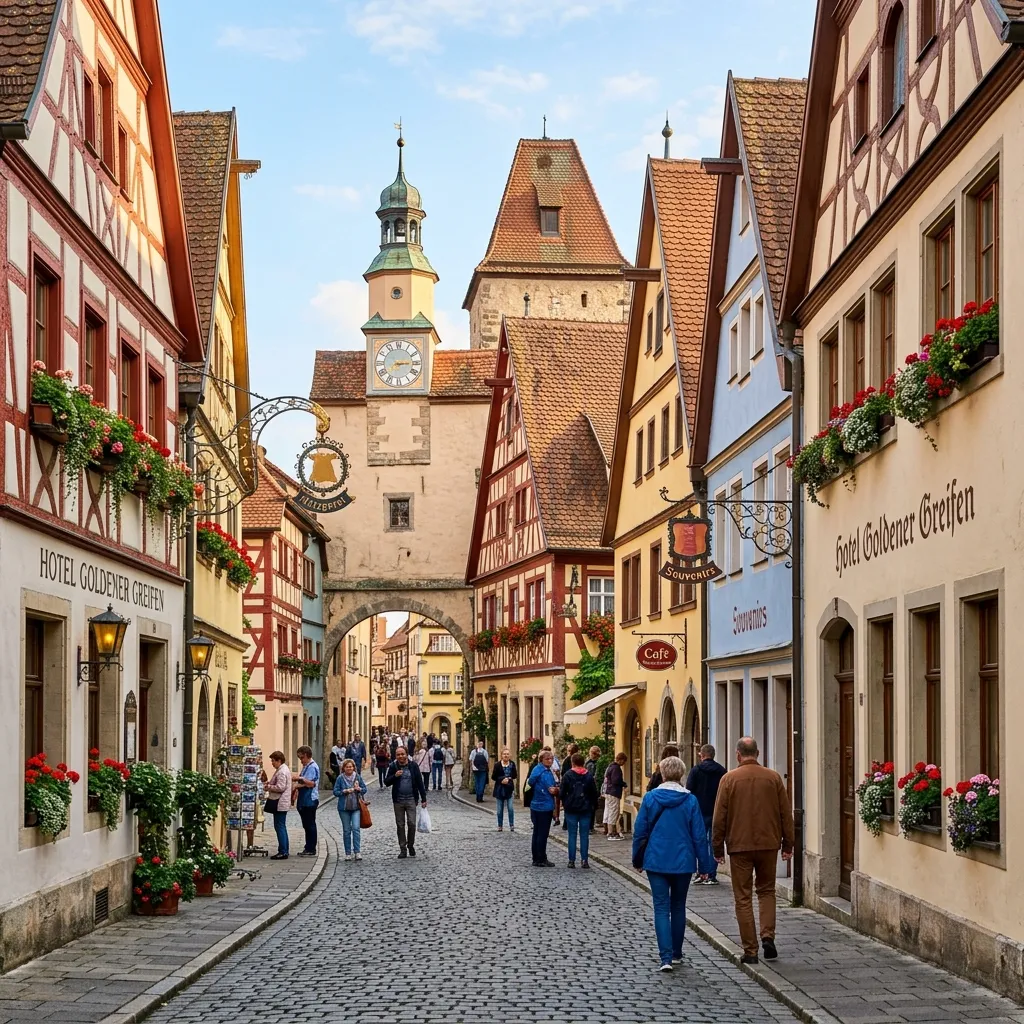
Cobblestone streets of a medieval European town with colorful half-timbered houses and a clock tower
Viking Cruises offers something completely different: Trade Routes of the Middle Ages is a 15-day ocean cruise that retraces the medieval trade routes from Bergen (Norway) to Barcelona (Spain).
Route: Bergen → North Sea → Amsterdam → Bruges → Paris (Le Havre) → Portsmouth → Falmouth → Atlantic Ocean → Porto → Granada (Málaga) → Murcia (Cartagena) → Barcelona
Duration: 15 days
What to Expect:
This is not a river cruise — it's an ocean cruise that follows the trade routes that defined the medieval European economy. From the Hanseatic League in the north to Mediterranean commerce in the south, you sail the same route that merchants used 700 years ago.
Itinerary Highlights:
Bergen, Norway: Starting point and one of the most important cities of the Hanseatic League. The Bryggen district (UNESCO World Heritage) preserves the wooden houses of medieval merchants. This is where Norwegian dried cod was traded for grain, textiles, and spices from the south.
Amsterdam, Netherlands: Medieval trading capital that would become the financial center of the world. Explore the canals, museums, and the city's mercantile heritage.
Bruges, Belgium: One of the best-preserved medieval cities in Europe. In the 14th century, it was one of the largest trading centers in the world. Market Square, the 83-meter Belfry, and canals that earned the city its nickname "Venice of the North."
Paris (Le Havre), France: Excursion to Paris or exploration of the Normandy coast. Medieval Normandy includes abbeys, castles, and villages that seem frozen in time.
Portsmouth, England: Home of the HMS Warrior and the historic naval dockyard. Connections to medieval English naval history and a departure point for the Crusades.
Porto, Portugal: A stunning medieval city with the Ribeira district (UNESCO World Heritage), the 12th-century Cathedral-Fortress, and the famous port wine cellars on the opposite bank of the Douro.
Granada (Málaga), Spain: The last Moorish stronghold on the Iberian Peninsula. The Alhambra is one of the most spectacular medieval monuments in the world — a palace-fortress blending Islamic and Christian architecture.
Barcelona, Spain: Final port of call featuring the Gothic Quarter, the 13th-century Barcelona Cathedral, and the Catalan medieval legacy.
Viking Differentiators:
- Mid-sized ocean ship (930 passengers) — smaller than mega-ships but with greater stability at sea
- Onboard lectures and talks about medieval history, trade routes, and port culture
- Included shore excursion at every port
- Nordic spa with sauna and snow room
- Regional cuisine menus that change along the route
Why Choose This Cruise: It's the most ambitious and comprehensive of the three. Instead of focusing on one region, it connects all of medieval Europe — from the Scandinavian north to the Mediterranean south. It's perfect for anyone who wants to understand how medieval trade shaped modern Europe. The ocean perspective offers something river cruises can't: the feeling of actually sailing as medieval merchants sailed.
Link: vikingcruises.com
Quick Comparison
| Riviera Travel | AmaWaterways | Viking | |
|---|---|---|---|
| Type | River Cruise | River Cruise | Ocean Cruise |
| Duration | 8 days | 7 nights | 15 days |
| River/Sea | Main + Main-Danube Canal | Rhine | Ocean (Bergen → Barcelona) |
| Passengers | ~190 | ~156 | ~930 |
| Price | From $2,849 | Check website | Check website |
| Focus | Medieval Germany & Romantic Road | Rhine Valley & castles | Pan-European trade routes |
| Best For | German history fans, budget-friendly | Premium experience, foodies | Big-picture medieval Europe |
Swipe sideways to see the full table →
What to Pack
Essentials:
- Comfortable walking shoes for cobblestones (seriously, this is crucial)
- Layered clothing — European weather changes quickly
- A light rain jacket
- Camera or smartphone with a good camera — the photo opportunities are endless
- European power adapter
- A notebook or notes app for recording the history of each place
For RPG / Fantasy Fans:
- Use the real-world settings as inspiration for your campaigns
- Rothenburg ob der Tauber is literally the visual reference for countless medieval fantasy villages
- The medieval taverns of Bamberg and Miltenberg are perfect templates for D&D tavern encounters
- The Rhine Valley with its ruined castles is pure worldbuilding material
Best Time to Go
Spring (April-May): Mild temperatures, flowers in bloom, fewer tourists. Ideal for photography.
Summer (June-August): Longer days, warm weather, but more crowded and more expensive. Beer and wine festivals.
Fall (September-October): Arguably the best season. Spectacular autumn foliage, grape harvest (Weinlese), harvest festivals, and lower prices.
Winter (November-December): Medieval Christmas markets. Some routes offer Christmas-themed cruises with stops at traditional markets. Magical but cold.
Practical Tips
Book early: The most popular medieval cruises sell out months in advance, especially for balcony cabins.
Travel insurance: Always get it. Cruises involve multiple countries and complex logistics.
Gratuities: Each company has a different policy. Riviera Travel includes gratuities. AmaWaterways and Viking typically add them automatically.
Excursions: The included excursions are generally good, but consider exploring on your own at some ports — that's when you discover the hidden treasures.
Language: On river cruises, staff speak English. In ports, English is widely spoken in Germany, the Netherlands, and Scandinavia. In Portugal and Spain, knowing a few local phrases goes a long way.
Connectivity: Wi-Fi is available on ships, but quality varies. On river cruises, the signal can drop in rural stretches. Use that as an opportunity to disconnect and enjoy the scenery.
Final Thoughts
Medieval cruises are a unique way to travel through Europe. Unlike land tours, you unpack once and your hotel moves with you. Unlike ocean cruises, you're always close to land, with new cities to explore almost every day.
For history nerds, medieval fantasy fans, RPG players, or anyone who has ever looked at a ruined castle and wondered who lived there — these cruises are the perfect trip. You're not just visiting the Middle Ages. You're sailing through them.

About the Author
Danilo Sarcinelli
Danilo Sarcinelli is a traveler and lifelong geek who loves Magic: The Gathering, D&D, Harry Potter, Disney, Star Wars, Dragon Ball, and Zelda. He explores the world to map out the most epic locations, conventions, and landmarks for fellow fans.
Learn more about Danilo & the team →